
Free Parenting Worksheets: Printable Pages for Parents


Welcome! Below you will find free parenting worksheets designed to support your growth, strengthen your connection with your child, and build confidence in your parenting skills. These worksheets for parents are easy to use, practical for everyday challenges, and available as printable worksheets you can download and print at home.
Whether you’re looking to improve communication, set healthy boundaries, or reflect on your parenting style, these resources offer guidance and support.

Raising children is both rewarding and challenging, and many parents are looking for practical tools that help them grow, learn, and respond with confidence. Free parenting worksheets offer a simple and effective way to increase awareness, build skills, and make intentional changes that positively impact the parent-child relationship.
These worksheets for parents are designed to encourage reflection, spark meaningful conversation, and provide clear guidance rooted in everyday parenting experiences. From understanding your child’s emotions to setting limits, managing stress, or building routines, worksheets serve as a hands-on resource that parents can work through at their own pace.


One of the greatest advantages of printable worksheets is accessibility—parents can download them instantly and use them at home, during family meetings, or even in collaboration with teachers, therapists, or support groups. Many parents appreciate having a tangible tool that helps them stay focused, track improvements, and revisit lessons as their child grows.


Whether you’re a new parent seeking direction, an experienced parent hoping to strengthen communication, or someone simply wanting to be more intentional in daily interactions, free parenting worksheets provide valuable insight and support. These printable worksheets help build skills, boost confidence, and empower parents to create positive, lasting change within their family.

Below are Text Links to Each of Our Free Parenting Worksheets:
"Limit-Setting & Boundaries" Worksheet
This worksheet guides parents in creating clear, consistent boundaries that support structure and emotional safety. It offers prompts for defining expectations, consequences, and communication strategies that reduce conflict and increase cooperation.
"Parenting Reflections" Worksheet
A guided journal-style worksheet that helps parents reflect on triggers, strengths, values, and areas for growth. It’s designed to improve self-awareness and promote more mindful and intentional parenting responses.
"Parenting Reflections" Quiz
This quiz supports parents in discovering patterns, automatic reactions, and beliefs that influence their parenting style. It offers insight that encourages positive change and helps parents understand how their responses shape their child’s behavior.
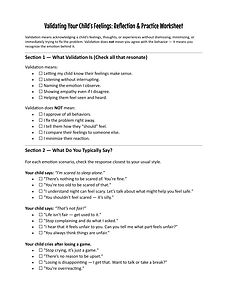
"Validating Your Child’s Feelings" Worksheet
This worksheet teaches phrases and communication techniques that validate emotions and build trust. Parents learn how to acknowledge feelings without judgment, fostering stronger emotional intelligence in their child.
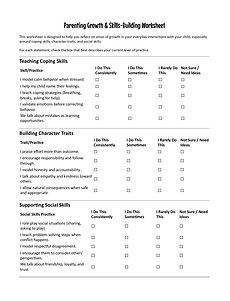
Helping Your Child with Skills-Building (Social Skills, Coping Skills, and Character Traits)
A hands-on worksheet that helps parents identify specific skills their child is developing and areas that need support. It includes strategies and practice ideas for social skills, emotional coping, and positive character traits.
"Fill-in-the-Blank" Parenting Worksheet
This interactive worksheet uses open prompts to help parents clarify goals, routines, challenges, and communication habits. It is customizable, making it perfect for working through individual family needs and situations.
Temperament Scale
A simple assessment tool that helps parents identify temperament traits such as adaptability, sensitivity, and activity level. Understanding temperament supports better communication, realistic expectations, and personalized parenting strategies.
Role-Modeling Chart
This chart helps parents track the behaviors, attitudes, and habits they want to model for their children. It encourages self-awareness and consistency, reinforcing that children learn most from what they see—not just what they hear.
Here are an additional 10 free parenting worksheets, covering such topics as: behavior management, parenting growth, stress management, boundaries, modeling, and more!
...and there's more!


